Induction Pressures: What to know before you say 'YES'!

That last month of pregnancy…..EISH!
It feels like your pregnancy lasts 8 months and a YEAR! At 38 weeks, you’re most likely tired, uncomfortable, and having disturbed sleep thanks to baby’s head sitting on your bladder. You are ready SO meet your baby now!
Having a midwife or consultant start talking about induction of labour may plant seeds of doubt into your thinking. “Maybe I’m going to be pregnant forever.” or perhaps, “My body has never done this before, so how will it know?” Or, as a mum already, perhaps your body has never gone into spontaneous labour and you’re doubting it ever will.
And now your due date has come, and you’re STILL waiting to go into labour!
This blog will help you understand what induction involves, when it’s necessary, and how to stay in control of your choices.
Induction of labour is almost standard practice now. The latest statistics for Northern Ireland’s inductions are 50% or more. (I have seen one trust having a 67% induction rate in July 2024 – absolutely shocking!) That is unnecessarily high, especially because inductions increase the need for pain medication, assisted delivery and/or caesarean sections. You need to understand why an induction is being offered to you and what the possible complications could be.
What exactly is an induction?
An induction is the process of artificially starting contractions of the uterus mechanically or with the use of pharmaceuticals. The first step is normally offering you a stretch and sweep to cause the cervix to release prostaglandins, which can trigger labour.
Reasons for Induction
- Pre-eclampsia
- Waters have broken without contractions starting within 24 hours
- Growth restriction
- Placental abruption
- Being ‘overdue’ (Read about Due Dates HERE)
- Reduced movements
- “Large” babies*
- “Small” babies*
- Unmanaged gestational diabetes
- Choleostasis
- Advanced maternal age

When is an induction necessary
Elective Induction
When a mother chooses to have her labour induced, or she agrees to the medical advice given to her, this would be considered an elective induction.
Precautionary Induction
Having an induction where it’s not quite a medical necessity but the option is there, however, there needs to be open and honest discussion with individualised recommendations given. For example, just because a woman is over 37, doesn’t mean her baby is in any danger. Many mothers of ‘advanced maternal age’ are making much healthier lifestyle choices over ‘younger’ mothers.
Another example is gestational diabetes. If a mother has been diagnosed but is managing her blood sugar levels through her diet, there should be no reason for an induction.
Often, if waters have broken and labour hasn’t started within 24 hours, you will be told to come in to have your labour started. However, you may prefer to monitor your temperature and keep things out of the vagina to reduce the chance of infection.
60-70% of women start labour within 24 hours and 90% within 48 hours. (as seen on NHS Kings Cross website)
Medical reasons for an Induction
There are definite medical indications where having an induction can be life-saving to you and/or your baby. These would include:
- pre-eclampsia and HELLP
- unmanaged diabetes
- cholestasis
- Uterine infection
- Fetal compromise

As you can clearly see, induction of labour isn’t black and white. It is personal, nuanced, and should be open to discussion, allowing you to decide what is best for you and your baby. Your decision to accept or refuse should be supported by your care provider, not open for coercion or fear mongering,
"When nature doesn't work, it cannot be improved.
Technology does not enhance a natural process that is working, it can only mar or destroy it."Stewart (1988)
Can I refuse an Induction?
You can refuse any procedure or recommendation being offered to you. You can also ask more questions and then ask for more time before deciding what is right for you. (This blog on advocacy will help you)
It is essential that you know this. It’s is your body, your baby and your birth. You should have the final say in everything – well, you should! Your consent needs to be given before any procedure is carried out. If something is carried out, or performed in addition to another method, without your clear, informed consent, that crosses a legal line and is considered obstetric violence. You deserve to feel respected, not pressured or coerced into agreement. By the same token, if you are manipulated into doing what the health care professional says, this is coercion and bullying and needs to be called out. Just because it’s ‘hospital policy’ doesn’t mean you have to submit to it. The maternity staff are there to provide a service for you and your individual needs.
Between 38-40 weeks you will have the ‘induction of labour’ discussion with your health care provider. They will probably book a date for you, too.
- You can refuse their offer of induction of labour.
- If that is too confrontational for you, phone in a few days later to cancel.
- Don’t show for the appointment – HOWEVER, with maternity services already stretched, this will add to it.
- You can let them know you will be open to re-discuss induction of labour if you are still pregnant by a certain date.
When having to decide whether to induce your labour or not, I would recommend you use your BRAIN!
Using your Brain:
B Benefits of procedure
R Risks to me and my baby of having or not having procedure
A Alternatives
I Intuition (what is my motherly instinct telling me?)
N Nothing- what if we do nothing

When induction is being discussed, it’s okay to slow the conversation down and ask for more detail. These questions can help you understand what’s being recommended and why, so you can decide what feels right for you.
Ask about the ABSOLUTE RISK
What is the absolute risk of this happening?
(Not just the percentage increase, but how often it actually occurs.)
Relative risk can sound frightening, but absolute risk helps put things into real-world context and can make the information easier to understand.
For example: You might hear something like:
“The risk of stillbirth doubles after 40 weeks.”
That statement can sound very frightening – but on its own, it doesn’t explain how likely this actually is.
When we look at the absolute risk, the picture becomes clearer.
At around 40 weeks, the risk of stillbirth is approximately 1 baby in 1,000
At around 41 weeks, the risk increases to approximately 2 babies in 1,000
So while the relative risk has doubled, the absolute risk increases by 1 additional baby per 1,000 pregnancies. If we flip that into more positive language, there is a 99.9% chance of not having a stillbirth. At 41 weeks, there is a 99.8% chance of not having a stillbirth.
Doesn’t that put things into a better perspective?
Ask About Real-Life Experience
How often have you personally seen this happen?
This can give a helpful perspective and may highlight whether something is common or relatively rare in practice.
Ask Whether This Is Routine or Individualised
Is this recommendation made for everyone, or is it specific to me and my baby?
This helps clarify whether induction is being suggested as a blanket policy or because of your individual circumstances.
Ask About YOUR Current Situation
Is there anything concerning happening right now that I should be aware of?
This can help distinguish between a preventative recommendation and an urgent medical concern requiring immediate action.
You are allowed to ask questions. You are allowed to take time. And you are allowed to make decisions that feel right for you. Informed choice isn’t about refusing care — it’s about understanding your options so you can consent with confidence.
~A Gentle Reminder~
Why not download my FREE 10-page Advocacy cheat sheet which gives you tools to use, especially when you go against the recommended advice.
Risks of Induction of Labour
As with any medical procedure, there are risks to consider. You decide whether the benefits outweigh the risks, and whether you would like to proceed or decline.
A large observational study found that induction of labour without a medical indication was associated with higher rates of interventions, increased short-term neonatal risks, and more long-term hospital admissions for infections up to age 16 compared with spontaneous labour.
Let have a look at the risks of Induction:
- Increased rate of epidural, instrumental birth, caesarean section, and episiotomies (cutting of the perineum)
- Increased chance of postpartum haemorrhage, especially for first births.
- Short term, there are higher rates of NICU admission, asphyxia, birth trauma resuscitation and respiratory disorders in babies
- Long term, there are higher rates of hospital admission for ear, nose and throat infections.
Understanding the Cascade of Interventions

Once an intervention (or even a test) is introduced, no matter how minor, it often leads to another… and another. Each step is usually well-intentioned, designed to reduce risk or offer reassurance. But when interventions are introduced without full context, nuance, or informed choice, they can quickly snowball into what’s commonly referred to as the cascade of interventions.
So what does that actually look like in real life?
You’re nearing your due date. One morning, you wake up wondering if your waters may have broken. Unsure, you call the maternity unit. They suggest you come in “just to be checked.”
It sounds simple enough. But even leaving your home – your familiar, safe environment – can be the first subtle shift away from your natural rhythm, or preferred birth preference. Once at the hospital, a midwife performs a vaginal examination and confirms that your waters have indeed gone. You’re told that labour needs to begin within 24 hours to reduce the risk of infection, and that if it doesn’t, labour will need to be initiated.
This is often the first moment worth pausing to ask:
What are my options here, and what happens if I say yes, no, or not right now?
From here, the cascade can unfold quietly.
You’re admitted “just in case” and placed on continuous monitoring to keep an eye on the baby. The monitors restrict your movement, making it harder to walk, sway, or find instinctive positions that support labour progress.
As time passes and contractions don’t begin on their own, induction is recommended. Synthetic oxytocin is started to stimulate labour. The contractions quickly become stronger, closer together, and way more intense than spontaneous labour.
To cope with the intensity, you’re offered pain relief. An epidural seems like the most effective option. Once placed, movement becomes even more limited, and labour may slow. To keep contractions strong enough, the oxytocin drip is increased.
Because epidurals can affect blood pressure, you’re monitored more closely. A drop in blood pressure can lead to changes in the baby’s heart rate, prompting concern from staff. The room begins to fill with people. The language becomes more urgent.
You’re encouraged to push in specific positions that allow easier monitoring, even if they don’t feel natural or effective. After a prolonged pushing phase, you’re told the baby needs help to be born, perhaps with forceps, a vacuum, or, if concerns escalate, a caesarean section.
None of these steps were intended to cause harm. Each was introduced to solve a problem created by the step before it. And yet, by the time the baby is born, the experience may look very different from what you initially imagined when you made that first phone call “just to be checked.”
This is the cascade of interventions – not as a failure of care, but as a reminder that every intervention, however small, can shift the direction of your labour. Understanding this doesn’t mean refusing help; it means recognising that informed choice, context, and timing matter at every step.
The Induction Process
If you decide to go ahead with the induction that has been offered to you, there will be an internal vaginal examination examination. This procedure will assess the position of your cervix, and how soft, long and dilated it is. (Bishop score) Then, according to the favourability of your cervix, that will determine what the next step will be. For example, if your cervix is 1 cm dilated, a stretch and sweep will most likely be offered as the first step. After a few days, another examination will be given, and if the cervix is further dilated, you may be given the Foley bulb, or offered a prostaglandin medication to dilate your cervix so that it is favourable for your waters to be broken.
There are 3 steps in the induction process:
- Ripening the cervix
- Breaking the amniotic sac
- Encouraging contractions
1) Ripening the Cervix
We don’t quite know what starts labour, but we think baby secretes a hormone when their lungs are ready for life outside the womb. When labour starts, hormones are released that will cause the cervix to soften and dilate. Oxytocin is released from the mother’s brain to oxytocin receptors on the outside of the uterus. The oxytocin causes the muscles of the uterus to contract. This contracting pushes baby’s head down onto the cervix, which causes more dilation, and more oxytocin to be released, and so this positive feedback cycle continues
The cervix needs to be favourable for induction to be effective before stimulating contractions. In other words, the cervix needs to be soft and slightly dilated.
Stretch and Sweep
Some would say that a stretch and sweep (or membrane sweep) is not a form of induction, but artificially stimulating the cervix to start contractions is interfering with the natural process of labour, and is thus an intervention.
The midwife will perform a vaginal examination (VE) to assess the cervix. If it is dilated to at least 1 cm, she will then use her fingers to try and separate the amniotic sac from the uterus causing the cervix to release prostaglandins which can trigger labour.
Having a membrane sweep may cause you to go into labour without further interventions. According to research carried out there is no clear evidence that a stretch and sweep is effective in starting labour, compared to waiting for spontaneous labour.
Side effects and Risks:
- Pain
- Bleeding
- Irregular contractions which may leave you tired and exhausted
- Accidental rupture of membranes
- Increased chance of infection
Foley Bulb/Dilapan
With the Foley bulb, a catheter with a deflated balloon device is inserted through the vagina to the cervix. The balloon is then inflated with a saline solution and left in place for up to 24 hours. This causes gentle pressure and stretching of the cervix, causing prostaglandins and oxytocin to be released, which may encourage contractions.
Dilapan rods work in a similar way to the Foley bulb. The rod is inserted into the cervix, which absorbs fluids, causing the cervix to stretch and soften.
Either of these mechanical methods of induction are a safe option if you’ve had any surgical procedure on your uterus.
Side effects and Risks:
- Discomfort and cramping
- Accidental rupture of membranes
- Cervix may close once bulb/rod removed
- Increased chance of infection

Artificial Prostaglandin
Synthetic prostaglandin comes as a gel (Prostin), pessary (Cervidil) or an oral tablet (Misoprostol). The gel is placed around the cervix, while the pessary is positioned inside the cervix when it has sufficiently dilated. The mother and baby will have to be monitored closely in the hospital with the use of continual fetal monitoring. After several hours, if the cervix hasn’t dilated sufficiently, another dose of Prostin/Cervidil will be given.
Side effects and risks:
- Sharp pains around the cervix
- Uncomfortable uterine cramps
- (Nausea, vomiting, diarrhoea, increased temperature are less common)
- (Hyper-stimulation of the uterus is a rare side effect)
- Hyperstimulation of the uterus.
- Uterine rupture
- Risk of hypoxia (lack of oxygen) to the baby because of long contractions with a short break.
- (Risk of amniotic fluid embolism is VERY rare)
2) Breaking the water
The next step in the induction process is breaking the waters, although some hospitals will use synthetic oxytocin first. The artificial rupture of the membranes (ARM) is performed with a long crochet-type hook that reaches through the cervix, hooks onto the membrane sac, and breaks it open, releasing the amniotic fluid. The cervix needs to be slightly dilated and thinned before proceeding.
If your waters have already broken, you’ll go straight to the oxytocin drip to get contractions started.
Side effects and risks
- It may be uncomfortable, but there should be no pain when breaking the amniotic sac.
- Initial stress response from baby resulting in an increased heart rate reading.
- Baby’s head may be scratched from the amnihook.
- Increased chance of infection
- Increased chance of umbilical prolapse if baby is too high in the pelvis.
- May cause malposition of baby’s head, resulting in prolonged labour.
- Contractions may be more painful as there is no more cushioning between baby’s head and uterus.
- Breaking blood vessels if there are any in the amniotic sac (rare) or if there is a velamentous cord insertion.
3) Encouraging contractions
Now your body has been ‘encouraged’ to dilate and, perhaps, baby’s amniotic fluid has been drained too. If contractions haven’t started, or perhaps they’ve slowed down in a physiological birth progression, you will be offered a drip of synthetic oxytocin.
Natural Oxytocin
Your baby and your body start a beautiful dance as natural (physiological) labour begins. As baby’s head pushes on the cervix, nerve receptors send a signal to the brain to produce oxytocin. Oxytocin is released causing contractions in the uterus. The cervix dilates and thins, baby’s head descends further into the pelvis, putting more pressure on the cervix. The nerve receptors send a message to the brain to produce more oxytocin and so the cycle continues until baby is ready to be born.
This dance slowly builds up in intensity, building your tolerance and releasing pain-relieving Beta endorphins which are several times stronger than opiates like morphine.
Synthetic oxytocin
Artificial oxytocin, Syntocinon, is given via a drip to start, or re-start (augment), contractions that will increase in length, strength and get closer together. This synthetic hormone does not pass across the blood/brain barrier, and therefore, the brain is not triggered into producing any beta endorphins. Natural oxytocin is prevented from being optimally released, which can interfere with mother/baby bonding after birth.
Continual monitoring will be necessary when using Syntocinon to monitor your contractions and how baby is responding to the contractions. This will limit your movements to around the drip and CTG monitor. This often results in limited movement and you birthing on the bed on your back, which is not ideal.
Side Effects and Risks:
- Regular vaginal examinations (2-4 hourly)
- Use of CTG (cardiotocograph) monitoring
- Active management of birthing the placenta
- Contractions more painful, leading to use of opiods/epidural
- Limited movement
- Hyperstimulation of the uterus
- Fetal distress
- Increased chance of caesarean birth
- Water retention
- Difficulty bonding
- Difficulty establishing breastfeeding
- Increased risk of postpartum haemorrhage
- Placental abruption (rare)
- Increased risk of shoulder dystocia
Contra-Indications of Synthetic Oxytocin
It is important to be aware that there are contra-indications to using Syntocinon:
- Latex allergy
- Any previous surgery to the uterus or cervix.
Outcomes of Induction of Labour vs Spontaneous Labour
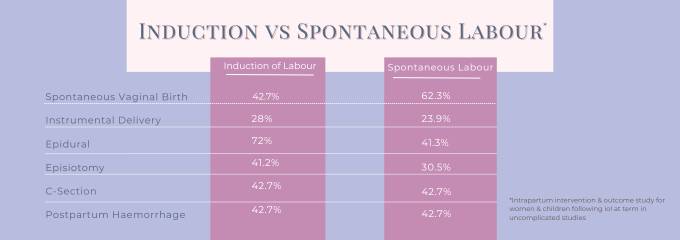
From a 2019 study, “Intrapartum interventions and outcomes for women and children following induction of labour at term in uncomplicated pregnancies: 16 year population-based linked data study” the following outcomes were seen:
Is it safe to wait beyond 41 weeks?
I have had many women tell me they have been told by professionals that their chances of stillbirth double after 41 weeks.
Guidelines tell us that the average length of a pregnancy is between 37-42 week, so surely if 41 weeks is still within the average gestation, baby isn’t ready to be born yet.
The last few weeks of pregnancy are vitally important for baby as they accumulate brown fat, needed for temperature regulation. Their brain and neurological development continue to mature, and their lungs mature for breathing. As far as your body goes, that beautiful cocktail of hormones bathes your body, preparing you emotionally and physically for labour and meeting your baby. Forcing labour to start before your body and baby are ready can have negative consequences, as we have seen.
I’m convinced that when a mother is told that her chances of stillbirth DOUBLE, she thinks that there is now a 50% chance of that happening. Data shows that the risks do in fact double after 41 weeks, HOWEVER, the actual numbers are important:
- The chances of stillbirth at 40 weeks are 6 in 10,000. That’s a 0.06% chance of stillbirth.
- The chances of stillbirth at 41 weeks are 12 in 10,000, which is a 0.12 chance of stillbirth, which is double.
As you can see, our risk doesn’t double to 50%. There is still a 99.98% chance there will NOT be a stillbirth at 41 weeks.
Can I still use the birth pool if I decline an induction
The simple answer is yes! However, in reality, you may have to push back to get your wishes granted. I would strongly suggest taking an advocate with you – maybe your partner or a doula, who can ask pointed questions, and challenge the policy.
If you are being denied a birth pool for refusing an induction, that is coercion. Pain relief is a human right. Full water immersion is the second most effective pain relief option – with an epidural being first.
Have this discussion before your labour begins. Speak to the consultant midwife if necessary, and have it signed off in your notes. That way, you won’t have to argue and contend for your requests when you’re in labour.
Conclusion
An induction of labour is an intervention that may involve several days of discomfort and a lack of sleep and rest. There is no gradual buildup of hormones that release your own natural opiates. You have to use medical pain relievers, which will affect both you and your baby. However, being fully informed beforehand, knowing the reasons for induction and the benefits and risks, will help you make decisions that have been weighed up from all angles.
I would strongly suggest taking an independent childbirth education class, and investing in a doula while you are pregnant. Knowledge is power! Making informed decisions puts you in control of your birth. Evidence shows that having a doula improves the birth experience by 69%. (Here’s the evidence article) This is due to building a relationship of trust where the mother is given all the necessary information and then is supported in her choices. Space is made to advocate for the mother’s wishes in the birth room, irrespective of hospital policies or health care providers’ preferences.
If you’ve decided that an induction is the right route for you and your circumstances, read this blog on How to have a positive induction
Recommended Resources
- Inducing for Due Dates on Evidence Based Birth website.
- In Your Own Time by Sara Wickham
- Induction Matters by Rachel Reed
- Great Birth Rebellion Podcast on Risks of Induction Part 1
- Great Birth Rebellion Podcast on Risks of Induction Part 2
- Best NHS Guidelines on Risks of Induction
P.S.: Don't forget your freebie
P.S. Worried you’ll freeze or forget what to say when it matters most?
Scroll down and grab my 10-page Advocacy Cheat Sheet.
It’s designed for those moments when decisions feel rushed, and pressure is high.
Inside:
• 5 gentle ways to say no without confrontation
• The exact questions that slow things down
• A clear reminder of your rights
• Practical prompts your birth partner can use to advocate for you
Download it now, so you can print it, save it, or keep it on your phone.
Sent straight to your inbox.